
Every professional athlete knows the next tackle could be their last one.
Most just don't plan like it.
The average New Zealand professional rugby career lasts nine years. That comes from the NZ Rugby Players' Association, which surveyed 123 former professionals, almost half of them All Blacks. The average retirement age was 32.
And plenty of players don't get to choose when they finish. In a survey of retired Irish professionals, 41% said injury forced them out of the game. Nine in ten saw their income drop in the first two years after retiring.
So the real question isn't how much you earn while you're playing.
It's what that money is still doing for you when you're 45.
What professional athletes actually earn
Here's what the numbers look like right now.
Super Rugby: retainers range from $75,000 to a maximum of $195,000. Players with a few seasons behind them typically earn $200,000 to $250,000 all up.
Playing overseas: those same players can command $600,000 to $800,000 a season in Japan or Europe. A one-season sabbatical deal in Japan for a top All Black can be worth $1 million to $2 million.
NRL: the average salary sits around A$400,000, with the minimum at about A$135,000 in 2026 and rising to A$145,000 in 2027.
That's serious money. For a short window.
Most athletes earn the bulk of their lifetime income in eight to ten years. And for most of that time, they're on the road, training twice a day, often living overseas.
No time to research suburbs. No time to chase agents. No time to deal with tenants.
That's exactly where most athletes get stuck.
Meet Athlete A and Athlete B
Both are 23-year-old Kiwi rugby players.
Both play four seasons of Super Rugby on around $220,000 a year. Both move to Japan at 27 on $700,000 a season.
At 30, both suffer a serious knee injury that ends their careers.
Eight seasons. Roughly $3.7 million in career earnings before tax. Identical careers, identical bad luck.
The only difference is what they did with the money.
Athlete B: enjoying it while it lasts
Athlete B does what a lot of young athletes do. A nice car. A flash apartment. Great holidays. He helps his family out, which is genuinely a good thing.
He tells himself he'll sort out investing after footy, when he has more time.
Then the injury comes.
At 30 he has around $150,000 in the bank and a fancy car. That cash carries him while he retrains and works out what's next.
At 45 he's renting, building a new career, and looking at property for the first time. The people he played with who invested early have 15 years of growth behind them. He's starting from zero.
He didn't do anything wrong. He just ran out of runway.
Athlete A: same lifestyle, one extra decision
Athlete A still enjoys his money. He still has the car and the holidays.
He just makes one extra decision early on.
At 25 he buys his first investment property for $400,000. Then, using his Japan contract, he buys one more each year at 27, 28 and 29.
Each purchase needs around $125,000 for the deposit and costs. That's $500,000 in total, or about 14% of his career earnings.
He has a team on the ground handling the sourcing, due diligence, property managers and tenants. He never misses a training session and is still focused on his career and team.
Then, at 30, the same injury.
But from here, his story looks very different.
Where they end up
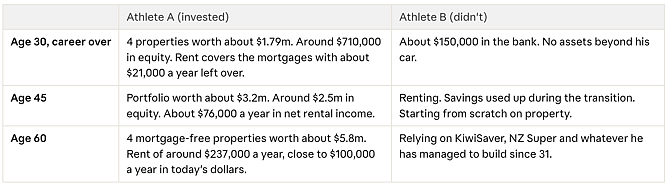
Same talent. Same earnings. Same injury.
One of them has a second income that doesn't care whether his knee works.
How we worked out the numbers
We kept this deliberately conservative.
Purchase price: $400,000 per property, in line with the higher-yield regional deals we source. One recent Waikato buy for an Australian client came in at $380,000 and rents for $700 a week, a 9.2% gross yield. Case Study here.
Rent: $600 a week to start, rising 3% a year, with 28% of rent set aside for rates, insurance, maintenance and property management.
Lending: 30% deposit, 5.5% interest, 30-year principal and interest loan.
Growth: 4% a year. That's below the 4.31% the national median has averaged over the last ten years, and well below the 5.7% a year NZ house prices outside Auckland have averaged since 1992.
No going again: Athlete A never uses his equity to buy more. Most of our clients do, which would grow the portfolio further.
All figures are before tax and are an illustration, not a promise. Property values can go down as well as up.
Use the big years well
You don't have to give up the lifestyle you've earned. Athlete A put aside about one dollar in every seven.
What made the difference was timing.
Your earning window is short. Assets outlast careers.
Rent doesn't stop when you get injured. A tenant pays the same whether you're starting on Saturday or in the physio's room.
Time does the heavy lifting. Athlete A only bought four properties. Thirty-plus years of growth did the rest.
The best time to start is while the money is coming in. Banks look at your income. It's far easier to buy while you're on a contract than after it ends.
The athletes who come out of their careers in great shape aren't always the highest earners. They're the ones who turned a few big years into assets that keep working for decades.
Why most athletes don't do it
It's rarely because they don't want to.
We find it's the time to do the research and buy the properties. It's being in another country. It's not knowing who to trust, and not wanting to buy the wrong property from the other side of the world.
That's exactly what we take care of for many high earners living overseas.
At Full Stack Property, we handle the whole process for you:
Strategy: we map out your goals, your budget and your game plan.
Find the right property: presenting you with the numbers, the risks and our recommendation.
Negotiate and check: full due diligence and getting the price right.
Settle and hand over: handed over with a property manager in place and tenants already in.
Revalue and go again: we review your strategy and use your equity to buy the next one.
With over 200 property buys and deals behind us, we do the hard yards on the ground. You make the final decision.
You focus on your game. We'll build the portfolio.
Penny's take
Fiona, our CEO, talks to a lot of athletes, and almost every one of them says the same thing: I'll sort it out when I finish; I can't think about it right now; I am saving a bit to do that all later.
The problem is that finishing isn't always your call.
You don't need to have it all figured out. You just need to start while the big contracts are coming in. Even one property bought in your mid-twenties can change what your thirties and forties look like.
If you're playing now, here or overseas, this is the conversation to have before your next contract, not after your last one.
Let's talk
Book a free chat with our team at fullstackproperty.co.nz. We'll look at where you are now, what you're earning, and what a portfolio could look like by the time you hang up your boots.
And if you know a player who should read this, send it their way.
This article is general information only and isn't financial advice. Property investing carries risk and we don't guarantee outcomes. Figures were accurate as of November 2026.
Sources
NZ Rugby Players’ Association, life after rugby research
https://www.nzrpa.co.nz/asset/182.pdfIrish Times, Four in 10 forced to retire due to injury
https://www.irishtimes.com/sport/four-in-10-forced-to-retire-due-to-injury-1.1274754NZ Herald, What All Blacks get paid and the overseas trend
https://nzherald.co.nz/sport/the-business-of-rugby-part-v-what-all-blacks-get-paid-and-the-worrying-overseas-trend/56442F2WGHTNTBDXRLVCQ2GPOUNZ Herald, Top All Blacks earn millions
https://nzherald.co.nz/sport/rugby/all-blacks/top-all-blacks-earn-millions-debunking-nz-rugbys-poor-narrative-gregor-paul/2VGJS6TTNNABNLO64KZXYXSDZIPlanet Rugby, Super Rugby salary cap and maximum retainer
https://www.planetrugby.com/news/full-extent-of-new-zealand-exodus-8-all-blacks-super-rugbys-hottest-prospect-and-the-biggest-blow-to-dave-rennieSEN, NRL average salary under the CBA
https://sen.com.au/news/2023/08/11/riccio-reveals-details-around-finalised-cba-agreementEsquire, Highest paid NRL players 2026
https://esquire.com.au/highest-paid-nrl-players-2026/Opes Partners, NZ median house price growth
https://www.opespartners.co.nz/investment/property-analysis/has-the-market-peakedOpes Partners, long-run NZ house price growth since 1992
https://www.opespartners.co.nz/property-management/rent-increases

